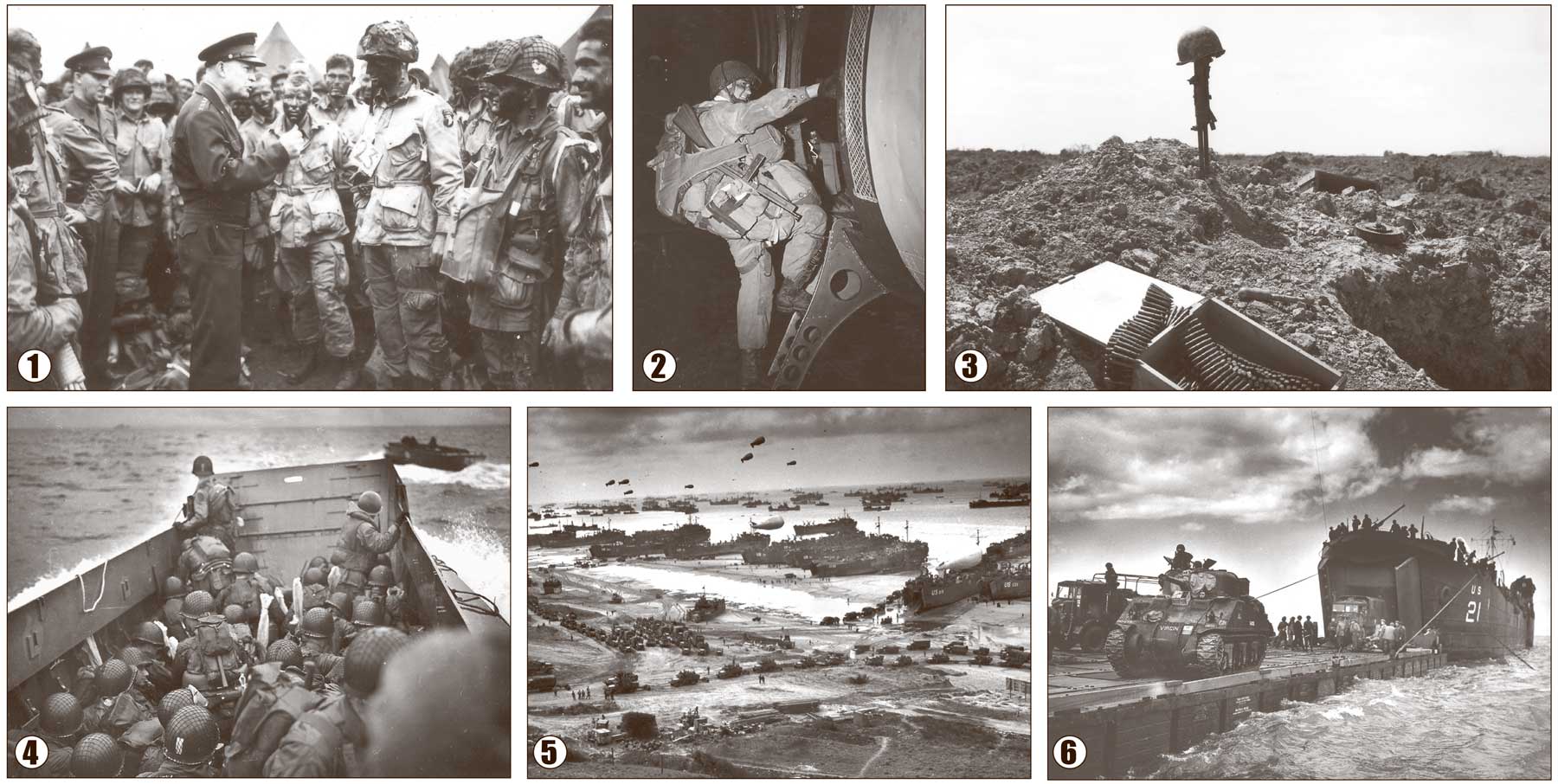
1) General Dwight D. Eisenhower, Supreme Commander of the Allied Expeditionary Force, speaks with Lieutenant Wallace C. Strobel, a paratrooper in the 101st Airborne Division, at England’s Greenham Common Airfield on the evening of June 5, 1944. Shortly after General Eisenhower’s visit, the men of the 101st boarded C-47 troop transports and departed for Normandy.
2) A heavily burdened paratrooper, armed with a Thompson M1 sub-machine gun, climbs into a transport plane bound for France.
3) A US helmet sits atop a captured German machine gun nest, marking the location at Pointe du Hoc of fallen comrades. Although there is no “official” figure, Allied casualties on June 6 are estimated at 10,000. The number of Axis casualties are estimated between 4,000 and 9,000 men.
4) Tightly packed troops crouch inside their LCVP (Landing Craft – Vehicle – Personnel) as it plows through a wave. In the distance is the coast of Normandy.
5) The Allied armada disgorges its cargo on Omaha beach. LSTs (Landing Ship –Tank vessels) have beached themselves and are unloading vehicles as freighters stand further off and are unloaded by DUKWs – the legendary, six-wheeled amphibious trucks used extensively by Allied forces during World War II. Affectionately nicknamed the “Duck,”, the name is not a military acronym, but a specific General Motors (GMC) factory manufacturing code: D: Designed in 1942. U: Utility (Amphibious). K: All-wheel drive capability. W: Twin, dual-tandem rear axles.
6) Without a deepwater port, constant supply and reinforcements were needed to break out of the beachhead. The solution was an artificial harbor built in England and brought to Normandy. Known by the codename “Mulberry,” two of these harbors were designed to unload men and supplies. Thousands of soldiers and sailors were involved in this effort. Spud barges that floated up and down with the tide formed the center of the harbor’s unloading activity. They were joined to the shore by floating roadways know as “Whales.” In addition to the floating roadways, special barges were constructed that could unload LSTs while afloat and bring vehicles directly to dry land.